How to Learn the Arabic Alphabet in 7 Days: The Ultimate Beginner’s Guide
Are you staring at the Arabic script and feeling like you’re trying to crack a secret code? You aren’t alone. Many students who want to learn the Arabic alphabet (the Alif-Ba) think it’s the hardest part of the language—but here is a secret: it’s actually the easiest.
Unlike English, Arabic is phonetic. Once you learn the letters, you can read almost any word! In this guide, we’re going to break down the 28 letters of Modern Standard Arabic (MSA) into a 7-day sprint.
Ready to stop scrolling and start reading? Let’s dive in!
Why the Arabic Alphabet is Easier Than You Think
Before we hit Day 1, let’s debunk some myths.
- There are only 28 letters. (Fewer than the 33 in Cyrillic/Russian!)
- Most letters are just “frames.” You just change the dots to change the sound.
- It’s written right-to-left. It feels weird for an hour, then it becomes second nature.
Stop! Before you start: Learning a language is 10x faster with a Tutor Book a Free Trial with us today and let a pro Tutor walk you through your first words!
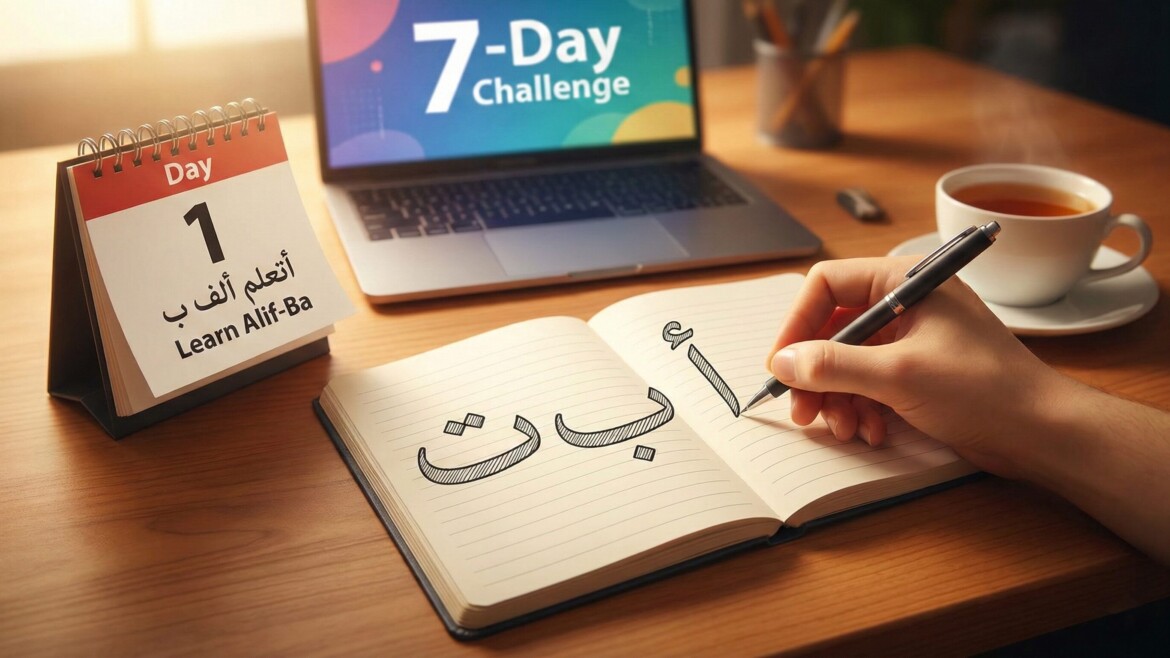
Day 1: Learn the Arabic Alphabet Foundations: Straight Lines & the Anchor (Alif to Ra)
Today, we focus on the foundation. Arabic is built on distinct shapes.
- Alif (أ): The tall, vertical pillar. Usually a long “aa” sound.
- The “Boat” Family (ث، ت، ب): These three share the same base shape.
- Ba (ب): One dot below (think “B” for “Below”).
- Ta (ت): Two dots above (looks like two eyes).
- Tha (ث): Three dots above (think “TH” for “Three”).
- The “Hook” Family (ج, ح, خ): * Jeem (ج): Soft “j” sound.
- Haa (ح): A deep, breathy “h” (like you’re breathing on glasses to clean them).
- Khaa (خ): The “ch” sound in “Bach.”
Day 2: Learn the Arabic Alphabet Through Curves & Non-Connecting Letters
Arabic is a cursive language, meaning letters connect like a string. However, some letters are “rebels”—they refuse to connect to the letter that follows them.
- Dal (د) & Thal (ذ): are simple curves. For example, Thal sounds like “the.”
- Ra (ر) & Zay (ز) look like bananas or slides.
- Check-in: Notice how Ra and Dal look similar? Because of this, focus on the “tail.” Ra always slides down below the line.
Day 3: The “S” Sounds and the “Heavy” Letters
This is where Arabic gets its unique “flavor.” Modern Standard Arabic distinguishes between light and heavy sounds.
- Seen (س) & Sheen (ش): Look for the three “teeth” of the comb.
- Sad (ص) & Dad (ض): These are the “Heavy” versions of S and D. To pronounce Dad, press your tongue against your upper molars. Fun fact: Arabic is often called “The Language of the Dad” because this sound is unique to Arabic!
Day 4: The “Eye” Shapes & The “Deep” Sounds
You’re halfway there! Don’t stop now.
- Taa (ط) & Zaa (ظ): Similar to the heavy sounds above, but with a vertical stick.
- Ain (ع) & Ghain (غ): The Ain is the most famous Arabic sound—it comes from the middle of the throat. The Ghain sounds like the French “R” or gargling water.
Day 5: Loops and Hooks (Fa to Laam)
These letters are very common and used in almost every sentence.
- Fa (ف) & Qaf (ق): Both are loops. Fa has one dot; Qaf has two and is a “deep K” sound from the back of the throat.
- Kaaf (ك): A standard English “K.”
- Laam (ل): Looks like a fishhook.
Day 6: The Final Stretch (Meem to Ya)
The finish line is in sight!
- Meem (م): A small loop. Think “M” for “Meem.”
- Noon (ن): A bowl with a dot inside.
- Ha (ه): A soft, light “h” (like “hello”).
- Waw (و): This doubles as the “w” sound and the “oo” vowel.
- Ya (ي): Looks like a duck! It makes the “y” and “ee” sounds.
Day 7: Learn the Arabic Alphabet Positions — Beginning, Middle, and End Forms
In Arabic, letters change shape slightly depending on if they are at the Beginning, Middle, or End of a word.
Wait! Don’t panic. Think of it like English cursive. A lowercase ‘g’ looks different when it connects to an ‘a’. It’s the same logic. Spend today looking at a “Positioning Chart” and practice writing your name.
Your Daily Practice Routine
- Write, Don’t Just Read: Muscle memory is key. Grab a notebook.
- Use Flashcards: Apps like Anki or Quizlet are great, but physical cards work best for script.
- Listen as You Write: You must associate the shape with the phonology. Visit Omniglot’s Arabic Page to hear the sounds of each letter.
Take the Next Step: From Letters to Conversations
Learning the alphabet in 7 days is an ambitious goal, but it is 100% possible with the right mindset. However, reading the letters is just the beginning. To truly speak and understand the soul of the Arab world, you need interaction.
At The Egyptian Arabic, we specialize in taking you from “What is this letter?” to “I’m having a full conversation!”
Ready to start your journey?
- 🚀 New to Arabic? Book a 1-on-1 Free Trial Lesson to get a personalized learning plan.
- 💰 Ready to commit? Check our available plans and find the one that fits your schedule and budget.
Comment below: Which Arabic letter is the hardest for you to pronounce? Let’s talk about it!