100 Essential Arabic Words for Daily Conversation (With Pronunciation & Examples)
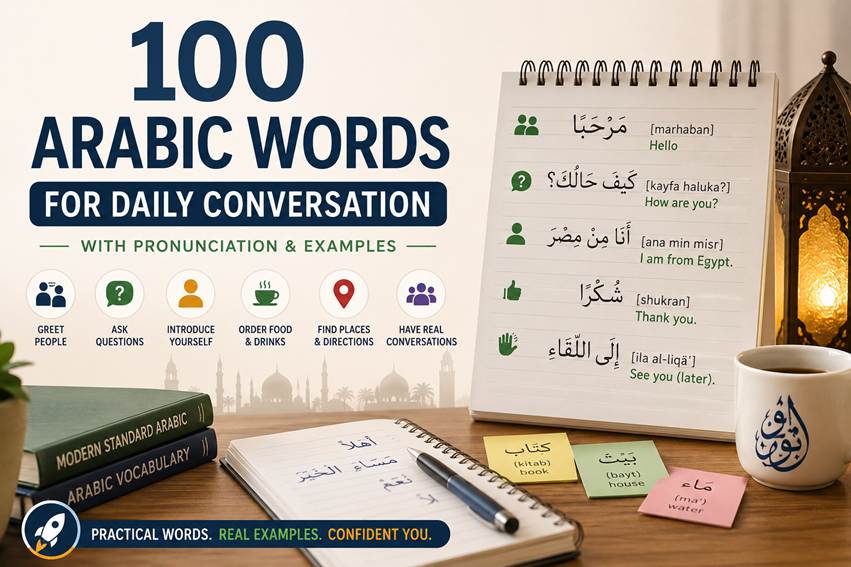
Want to learn 100 Arabic words for daily conversation and start using Arabic with confidence?
Introduction
The fastest way isn’t by memorizing long grammar rules—it’s by learning the words you’ll actually use in everyday conversations.
In this guide, you’ll learn 100 essential Arabic words through short, practical sections designed especially for beginners. Every word comes with easy pronunciation, a clear English meaning, and a simple example to help you use it immediately.
The vocabulary in this guide is presented in Modern Standard Arabic (MSA), which provides a strong foundation for everyday communication, further language study, and understanding Quranic Arabic. If you’re also interested in spoken Egyptian Arabic, explore our
Colloquial Egyptian Arabic course.
Whether you’re learning Arabic for travel, work, study, business, or to better understand the Quran, these words will help you build practical vocabulary that you can start using from day one.
Your first Arabic conversation starts now.
Quick Answer
The fastest way to start speaking Arabic is to learn the words you’ll use every day. This guide teaches 100 essential Arabic words through practical examples and short speaking activities that help you understand, pronounce, and use new vocabulary immediately.
What You’ll Learn
- Greet people and end simple conversations.
- Ask basic questions and understand common question words.
- Introduce yourself and talk about family.
- Order simple food and drinks.
- Build confidence through short, practical speaking activities.
👋 Meeting People
🎯 By the End of This Section, You’ll Be Able To:
- Say hello and goodbye.
- Greet someone politely.
- Thank someone.
- Respond to a greeting.
Words in this section: 10
Estimated time: About 5 minutes
📚 Learn
| Part of Speech | Meaning | Pronunciation | Arabic |
| Greeting | Hello | Marḥaban | مَرْحَبًا |
| Greeting | Peace be upon you | As-salāmu ʿalaykum | السَّلَامُ عَلَيْكُمْ |
| Reply | Peace be upon you too | Wa ʿalaykumu as-salām | وَعَلَيْكُمُ السَّلَامُ |
| Greeting | Hi / Welcome | Ahlan | أَهْلًا |
| Greeting | Good morning | Ṣabāḥ al-khayr | صَبَاحُ الْخَيْرِ |
| Greeting | Good evening | Masāʾ al-khayr | مَسَاءُ الْخَيْرِ |
| Farewell | See you later | Ilā al-liqāʾ | إِلَى اللِّقَاءِ |
| Farewell | Goodbye | Maʿa as-salāmah | مَعَ السَّلَامَةِ |
| Expression | Thank you | Shukran | شُكْرًا |
| Expression | You’re welcome / Excuse me | ʿAfwan | عَفْوًا |
💬 Real Conversation
| Translation | Arabic |
| A: Peace be upon you. | السَّلَامُ عَلَيْكُمْ. |
| B: Peace be upon you too. | وَعَلَيْكُمُ السَّلَامُ. |
| A: Good morning. | صَبَاحُ الْخَيْرِ. |
| B: Good morning. | صَبَاحُ النُّورِ. |
| A: Thank you. | شُكْرًا. |
| B: You’re welcome. | عَفْوًا. |
| A: See you later. | إِلَى اللِّقَاءِ. |
| B: Goodbye. | مَعَ السَّلَامَةِ. |
🌟 Native Speakers Say…
When someone says صَبَاحُ الْخَيْرِ, a very common reply is:
صَبَاحُ النُّورِ
This expression is widely used as a natural response to “Good morning.”
🎯 Try It Yourself
Say these expressions aloud.
- مَرْحَبًا
- السَّلَامُ عَلَيْكُمْ
- شُكْرًا
- مَعَ السَّلَامَةِ
Now introduce yourself.
- مَرْحَبًا، أَنَا ـــــــــــــــــ
- (Hello, I’m ________.)
✍️ Complete the Conversations
A: السَّلَامُ عَلَيْكُمْ
B: _______________________
A: شُكْرًا
B: _______________________
✅ Check Yourself
Can you now…
- ☐ Say hello.
- ☐ Say goodbye.
- ☐ Thank someone.
- ☐ Reply politely to a greeting.
🎉 Great Job!
- ✅ Greet someone politely.
- ✅ Respond to a greeting.
- ✅ Thank someone.
- ✅ End a simple conversation.
🎉 You’ve mastered your first 10 Arabic words!
🔗 Continue Learning
Ready to build your Arabic foundation? Learn the Arabic Alphabet in 7 Days and keep practicing.
❓ Asking Questions
Want to build a stronger foundation in Arabic? Learn more about our Modern Standard Arabic (Fusha) course.
🎯 You’ll Use These Words To:
- Ask simple questions.
- Find places.
- Get information.
- Start conversations.
Words in this section: 10
Estimated time: About 5 minutes
📚 Learn
| Part of Speech | Meaning | Pronunciation | Arabic |
| Question Word | Who | Man | من |
| Question Word | What | Mādhā | ماذا |
| Question Word | Where | Ayna | أين |
| Question Word | When | Matā | متى |
| Question Word | Why | Limādhā | لماذا |
| Question Word | How | Kayfa | كيف |
| Question Word | How much / How many | Kam | كم |
| Question Word | Which | Ayy | أي |
| Question Word | Question particle | Hal | هل |
| Question Phrase | What time | Ayy waqt | أيّ وقت |
💬 Real Conversation
| Translation | Arabic |
| A: Where is the restaurant? | أَيْنَ الْمَطْعَمُ؟ |
| B: Over there. | هُنَاكَ. |
| A: How much is this? | كَمْ هَذَا؟ |
| B: Ten dollars. | عَشَرَةُ دُولَارَاتٍ. |
🌟 Native Speakers Say…
Notice that هَلْ is placed at the beginning of a sentence to form a yes/no question.
Example:
هَلْ تَتَكَلَّمُ الْعَرَبِيَّةَ؟
Do you speak Arabic?
🗣️ Say It
Read these questions aloud.
- أَيْنَ؟ —-Ayna
- كَيْفَ؟ —Kayfa
- كَمْ؟ —Kam
- لِمَاذَا؟ —Limādhā
✍️ Your Turn
Complete the questions.
أَيْنَ __________؟
كَمْ __________؟
هَلْ __________؟
🎯 Challenge: Ask Real Questions
Imagine you’re talking to a shop assistant or a passerby.
Say these questions aloud:
- أَيْنَ الْمَطْعَمُ؟
- كَمْ هَذَا؟
- هَلْ تَتَكَلَّمُ الْإِنْجِلِيزِيَّةَ؟
✅ Can You Do It?
- ☐ Ask where something is.
- ☐ Ask a yes/no question.
- ☐ Ask how much something costs.
- ☐ Ask who someone is.
🎉 Great Job!
- ✅ Ask where something is.
- ✅ Ask simple yes/no questions.
- ✅ Ask about prices.
Progress: 20 / 100 Words
If you can ask these questions confidently without looking at the table, you’re ready to move on.
🙋 Talking About Yourself
🎯 You’ll Use These Words To:
- Introduce yourself.
- Say who you are.
- Talk about other people.
- Build your first complete Arabic sentences.
Words in this section: 10
Estimated time: About 5 minutes
📚 Learn
| Part of Speech | Meaning | Pronunciation | Arabic |
| Pronoun | I | Anā | أنا |
| Pronoun | You (male) | Anta | أنتَ |
| Pronoun | You (female) | Anti | أنتِ |
| Pronoun | He | Huwa | هو |
| Pronoun | She | Hiya | هي |
| Pronoun | We | Naḥnu | نحن |
| Pronoun | You (plural) | Antum | أنتم |
| Pronoun | They | Hum | هم |
| Expression | My name is | Ismī | اسمي |
| Noun | Student | Ṭālib | طالب |
Note: If the speaker is female, طَالِب becomes طَالِبَة (Ṭālibah).
💬 Real Conversation
| Translation | Arabic |
| A: Hello. | مَرْحَبًا. |
| B: Hello. | مَرْحَبًا. |
| A: What’s your name? | مَا اسْمُكَ؟ |
| B: My name is John. | اِسْمِي جُون. |
| A: Are you a student? | هَلْ أَنْتَ طَالِبٌ؟ |
| B: Yes, I am a student. | نَعَمْ، أَنَا طَالِبٌ. |
🌟 Native Speakers Say…
When introducing yourself in Modern Standard Arabic, a natural beginner pattern is:
اِسْمِي أَحْمَدُ.
(My name is Ahmed.)
Spoken dialects may use shorter or different patterns, but اِسْمِي… is widely understood and is a clear starting point for beginners.
🔗 Go Deeper
Want more practice introducing yourself? Read How to Introduce Yourself in Arabic on our blog.
🗣️ Say It
Read these sentences aloud.
- أَنَا طَالِبٌ.
- اِسْمِي مُحَمَّدٌ.
- هُوَ طَالِبٌ.
- هِيَ طَالِبَةٌ.
✍️ Your Turn
Complete the sentences with your own information.
اِسْمِي ____________.
أَنَا ____________.
هُوَ ____________.
✅ Can You Do It?
- ☐ Say your name.
- ☐ Introduce yourself.
- ☐ Say “I am…”
- ☐ Talk about another person.
🎉 Great Job!
- ✅ Introduce yourself.
- ✅ Say your name.
- ✅ Talk about yourself.
- ✅ Describe another person using simple Arabic.
Progress: 30 / 100 Words
🎯 Your Challenge
Introduce yourself aloud using at least three expressions from this section.
For example:
مَرْحَبًا، اِسْمِي سَارَةُ. أَنَا طَالِبَةٌ.
Or:
مَرْحَبًا، اِسْمِي جُونُ. أَنَا طَالِبٌ.
👨👩👧👦 Talking About Family

🎯 You’ll Use These Words To:
- Talk about your family.
- Introduce family members.
- Ask simple questions about relatives.
- Describe who is in your family.
Words in this section: 10
Estimated time: About 5 minutes
📚 Learn
| Part of Speech | Meaning | Pronunciation | Arabic |
| Noun | Family | Usrah | أسرة |
| Noun | Father | Ab | أب |
| Noun | Mother | Umm | أم |
| Noun | Brother | Akh | أخ |
| Noun | Sister | Ukht | أخت |
| Noun | Son | Ibn | ابن |
| Noun | Daughter | Ibnah | ابنة |
| Noun | Husband | Zawj | زوج |
| Noun | Wife | Zawjah | زوجة |
| Noun | Child | Ṭifl | طفل |
💬 Real Conversation
| Translation | Arabic |
| A: Do you have any brothers or sisters? | هَلْ لَدَيْكَ إِخْوَةٌ؟ |
| B: Yes, I have a brother and a sister. | نَعَمْ، لَدَيَّ أَخٌ وَأُخْتٌ. |
| A: Is this your family? | هَلْ هَذِهِ أُسْرَتُكَ؟ |
| B: Yes, this is my family. | نَعَمْ، هَذِهِ أُسْرَتِي. |
🌟 Native Speakers Say…
In Modern Standard Arabic, this is a simple and useful way to introduce your family:
هَذِهِ أُسْرَتِي.
(This is my family.)
🗣️ Say It
- هَذَا أَبِي.
- هَذِهِ أُمِّي.
- هَذَا أَخِي.
- هَذِهِ أُخْتِي.
✍️ Your Turn
Complete the sentences.
هَذَا ____________.
هَذِهِ ____________.
لَدَيَّ ____________.
✅ Can You Do It?
- ☐ Say “my father.”
- ☐ Say “my mother.”
- ☐ Talk about your brother or sister.
- ☐ Introduce your family.
🎉 Great Job!
- ✅ Talk about your family.
- ✅ Introduce family members.
- ✅ Describe simple family relationships.
Progress: 40 / 100 Words
🎯 Your Challenge
Introduce your family using at least three words from this section.
- هَذِهِ أُسْرَتِي.
- هَذَا أَبِي.
- هَذِهِ أُمِّي.
- لَدَيَّ أَخٌ.
🍽️ Ordering Food & Drinks
🎯 You’ll Use These Words To:
- Order food and drinks.
- Say what you want.
- Ask for something politely.
- Understand simple restaurant conversations.
Words in this section: 10
Estimated time: About 5 minutes
📚 Learn
| Part of Speech | Meaning | Pronunciation | Arabic |
| Noun | Water | Māʾ | ماء |
| Noun | Bread | Khubz | خبز |
| Noun | Rice | Aruzz | أرز |
| Noun | Chicken | Dajāj | دجاج |
| Noun | Meat | Laḥm | لحم |
| Noun | Fruit | Fākihah | فاكهة |
| Noun | Coffee | Qahwah | قهوة |
| Noun | Tea | Shāy | شاي |
| Verb | I want | Urīdu | أريد |
| Expression | Please | Min faḍlik / Min faḍlak | من فضلك |
Note: مِنْ فَضْلِكَ is used when speaking to a man, and مِنْ فَضْلِكِ when speaking to a woman. Beginners can learn the distinction gradually.
💬 Real Conversation
A: مَاذَا تُرِيدُ؟
B: أُرِيدُ قَهْوَةً، مِنْ فَضْلِكَ.
A: هَلْ تُرِيدُ مَاءً أَيْضًا؟
B: نَعَمْ، شُكْرًا.
🌟 Native Speakers Say…
A useful beginner pattern is:
أُرِيدُ … مِنْ فَضْلِكَ.
(I’d like … please.)
You can use the pattern with many everyday items: أُرِيدُ مَاءً. أُرِيدُ شَايًا. أُرِيدُ خُبْزًا.
Ready to practice beyond vocabulary? Book a Free Trial Lesson and use these expressions in a real conversation.
🎉 Great Job!
You can now:
- Order simple food and drinks.
- Ask politely for what you want.
- Use one of the most common sentence patterns in Arabic.
Progress: 50 / 100 Words
🔢 Numbers
🎯 You’ll Use These Words To:
- Count from 1 to 10.
- Understand simple prices.
- Talk about quantities.
- Prepare for shopping and everyday conversations.
Words in this section: 10
Estimated time: About 5 minutes
📖 Learn
| Part of Speech | Meaning | Pronunciation | Arabic |
| Number | One | Wāḥid | وَاحِد |
| Number | Two | Ithnān | اِثْنَان |
| Number | Three | Thalāthah | ثَلَاثَة |
| Number | Four | Arbaʿah | أَرْبَعَة |
| Number | Five | Khamsah | خَمْسَة |
| Number | Six | Sittah | سِتَّة |
| Number | Seven | Sabʿah | سَبْعَة |
| Number | Eight | Thamāniyah | ثَمَانِيَة |
| Number | Nine | Tisʿah | تِسْعَة |
| Number | Ten | ʿAsharah | عَشَرَة |
💬 Real Conversation
| Translation | Arabic |
| A: How much is this? | كَمْ هَذَا؟ |
| B: Five dollars. | خَمْسَةُ دَوْلَارَاتٍ. |
| A: How many cups would you like? | كَمْ كُوبًا تُرِيدُ؟ |
| B: I’d like two. | أُرِيدُ اثْنَيْنِ. |
🌟 Most Useful Pattern
كَمْ + العدد
Use كَمْ to ask about quantity or price.
Examples:
- كَمْ هَذَا؟
- كَمْ كِتَابًا عِنْدَكَ؟
- كَمْ كُوبًا تُرِيدُ؟
🗣️ Say It
Count aloud from one to ten.
وَاحِد، اِثْنَان، ثَلَاثَة، أَرْبَعَة، خَمْسَة، سِتَّة، سَبْعَة، ثَمَانِيَة، تِسْعَة، عَشَرَة
✍️ Your Turn
Answer these questions.
كَمْ هَذَا؟
كَمْ كِتَابًا عِنْدَكَ؟
✅ Can You Do It?
Can you now…
- Count from 1 to 10.
- Understand simple prices.
- Say how many you want.
- Answer basic questions using numbers.
🎉 Great Job!
You can now:
- Count from 1 to 10.
- Understand simple numbers in conversations.
- Use numbers when shopping or ordering food.
Progress: 60 / 100 Words
⭐ Golden Sentence
أُرِيدُ اثْنَيْنِ، مِنْ فَضْلِكَ
(I’d like two, please.)
Try replacing اِثْنَيْنِ with different numbers you’ve just learned.
🛍️ Shopping
🎯 You’ll Use These Words To:
- Buy everyday items.
- Ask about prices.
- Pay for your purchases.
- Have simple conversations in shops.
Words in this section: 10
Estimated time: About 5 minutes
📖 Learn
| Part of Speech | Meaning | Pronunciation | Arabic |
| Noun | Store / Shop | Matjar | مَتْجَر |
| Noun | Market | Sūq | سُوق |
| Noun | Price | Siʿr | سِعْر |
| Noun | Money | Nuqūd | نُقُود |
| Noun | Buying / Purchase | Shirāʾ | شِرَاء |
| Verb | I buy | Ashtarī | أَشْتَرِي |
| Verb | I sell | Abīʿ | أَبِيع |
| Adjective | Expensive | Ghālin | غَالٍ |
| Adjective | Cheap | Rakhīṣ | رَخِيص |
| Noun | Receipt / Bill | Fātūrah | فَاتُورَة |
💬 Real Conversation
| Arabic | Translation |
| كَمْ سِعْرُ هَذَا؟ | A: How much is this? |
| عَشَرَةُ دَوْلَارَاتٍ. | B: It’s ten dollars. |
| إِنَّهُ غَالٍ. | A: It’s expensive. |
| لَدَيْنَا خِيَارٌ أَرْخَصُ. | B: We have a cheaper option. |
⭐ Golden Sentence
كَمْ سِعْرُ هَذَا؟
(How much is this?)
This is one of the most useful questions you’ll use while shopping.
🗣️ Say It
- إِنَّهُ غَالٍ.
- إِنَّهُ رَخِيصٌ.
- أُرِيدُ شِرَاءَ هَذَا.
✍️ Your Turn
Read these expressions aloud.
- كَمْ سِعْرُ هَذَا؟
Complete the sentences.
- هَذَا ____________.
- (غَالٍ / رَخِيصٌ)
- أُرِيدُ شِرَاءَ ____________.
✅ Can You Do It?
Can you now…
- Ask for a price.
- Say something is expensive.
- Say something is cheap.
- Buy something politely.
🎉 Great Job!
You can now:
- Ask about prices.
- Describe whether something is expensive or cheap.
- Buy simple items in Arabic.
Progress: 70 / 100 Words
📍 Places & Directions📍 Places & Directions
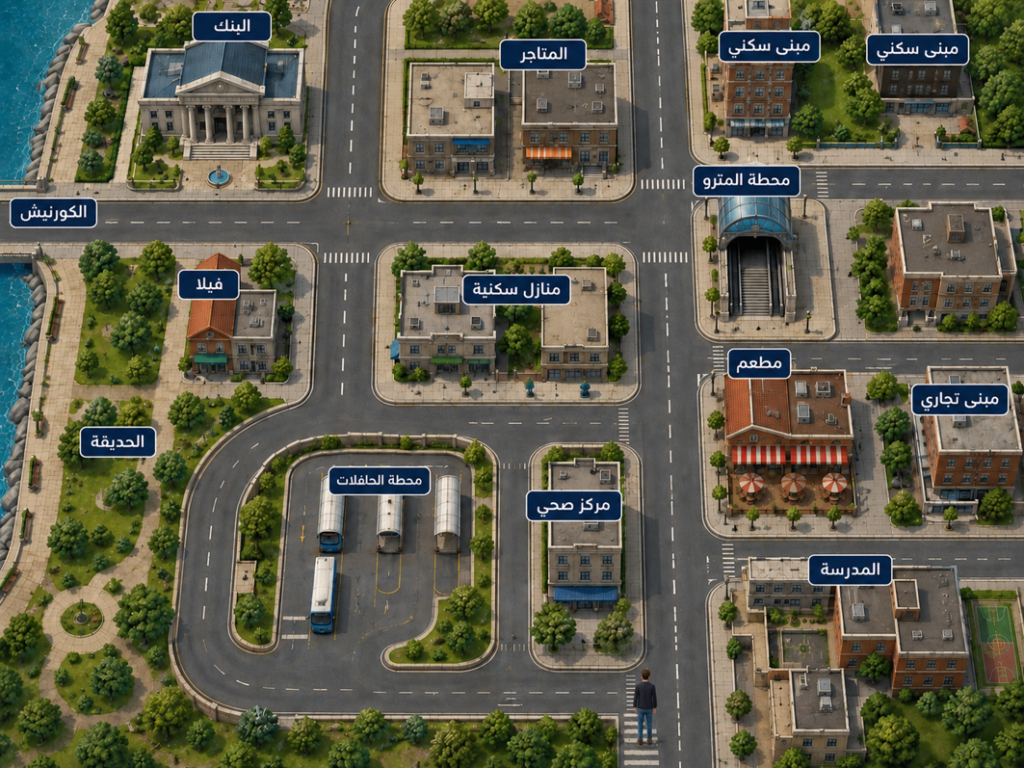
🎯 You’ll Use These Words To:
- Ask for directions.
- Understand simple location words.
- Find places in a city.
- Give simple directions to others.
Words in this section: 10
Estimated time: About 5 minutes
📖 Learn
| Part of Speech | Meaning | Pronunciation | Arabic |
| Noun | Place | Makān | مَكَان |
| Noun | Street | Shāriʿ | شَارِع |
| Noun | Road | Ṭarīq | طَرِيق |
| Direction | Right | Yamīn | يَمِين |
| Direction | Left | Yasār | يَسَار |
| Preposition | In front of | Amām | أَمَام |
| Preposition | Behind | Khalf | خَلْف |
| Adjective | Near | Qarīb | قَرِيب |
| Adjective | Far | Baʿīd | بَعِيد |
| Adverb | Here | Hunā | هُنَا |
💬 Real Conversation
| Translation | Arabic |
| Visitor: Peace be upon you. | السَّلَامُ عَلَيْكُمْ. |
| Local: Peace be upon you too. | وَعَلَيْكُمُ السَّلَامُ. |
| Visitor: Where is the market? | أَيْنَ السُّوقُ؟ |
| Local: The market is nearby. Walk straight ahead, then turn right. | السُّوقُ قَرِيبٌ. اِمْشِ إِلَى الأَمَامِ، ثُمَّ ادْخُلْ يَمِينًا. |
| Visitor: Thank you. | شُكْرًا. |
| Local: You’re welcome. | عَفْوًا. |
Visitor: Where is the market.
Local: The market is nearby. Walk straight ahead, then turn right.
Visitor: Thank you.
Local: You’re welcome.
⭐ Golden Sentence
- أَيْنَ ____________؟
(Where is ________?)
You can use this sentence almost anywhere:
- أَيْنَ الْمَتْجَرُ؟
- أَيْنَ السُّوقُ؟
- أَيْنَ الْمَطْعَمُ؟
🗣️ Say It
أَيْنَ السُّوقُ؟
- هُنَا.
- قَرِيبٌ.
- يَمِينٌ.
- يَسَارٌ.
✍️ Your Turn
Complete the questions.
أَيْنَ ____________؟
الْمَتْجَرُ ____________.
(قَرِيبٌ / بَعِيدٌ)
✅ Can You Do It?
Can you now…
- Ask where a place is.
- Understand simple directions.
- Say “right” and “left.”
- Describe whether a place is near or far.
🎉 Great Job!
You can now:
- Ask for directions.
- Understand simple location words.
- Find common places in Arabic.
Progress: 80 / 100 Words
⭐ Golden Sentence
أَيْنَ السُّوقُ؟
(Where is the market?)
Try replacing السُّوقُ with other places you’ve already learned:
- الْمَطْعَمُ
- الْمَتْجَرُ
- الْمَدْرَسَةُ
⏰ Talking About Time
🎯 You’ll Use These Words To:
- Talk about time.
- Describe your daily routine.
- Ask when something happens.
- Understand common time expressions.
Words in this section: 10
Estimated time: About 5 minutes
📖 Learn
| Part of Speech | Meaning | Pronunciation | Arabic |
| Adverb | Today | Al-yawm | الْيَوْم |
| Adverb | Tomorrow | Ghadan | غَدًا |
| Adverb | Yesterday | Ams | أَمْس |
| Adverb | Now | Al-ān | الْآن |
| Noun | Morning | Ṣabāḥ | صَبَاح |
| Noun | Evening | Masāʾ | مَسَاء |
| Noun | Hour / Clock | Sāʿah | سَاعَة |
| Noun | Time | Waqt | وَقْت |
| Adverb | Always | Dāʾiman | دَائِمًا |
| Adverb | Sometimes | Aḥyānan | أَحْيَانًا |
💬 Real Conversation
| Translation | Arabic |
| Adam: Peace be upon you, Omar. | السَّلَامُ عَلَيْكُمْ يَا عُمَرُ. |
| Omar: Peace be upon you too. | وَعَلَيْكُمُ السَّلَامُ. |
| Adam: When do you go to the market? | مَتَى تَذْهَبُ إِلَى السُّوقِ؟ |
| Omar: I go in the morning. | أَذْهَبُ صَبَاحًا. |
| Adam: Are you going today? | هَلْ تَذْهَبُ الْيَوْمَ؟ |
| Omar: Yes, I’m going now. | نَعَمْ، أَذْهَبُ الْآنَ. |
⭐ Golden Sentence
مَتَى ____________؟
(When …?)
Examples:
- مَتَى الدَّرْسُ؟
- مَتَى تَذْهَبُ؟
- مَتَى تَبْدَأُ؟
🗣️ Say It
Read these expressions aloud.
الْيَوْمَ
غَدًا
الْآنَ
صَبَاحًا
مَسَاءً
✍️ Your Turn
Complete the sentences.
أَذْهَبُ ____________.
(الْيَوْمَ / غَدًا)
أَدْرُسُ ____________.
(صَبَاحًا / مَسَاءً)
✅ Can You Do It?
Can you now…
- Say “today.”
- Say “tomorrow.”
- Ask “when?”
- Talk about simple daily activities.
🎉 Great Job!
You can now:
- Talk about time.
- Ask when something happens.
- Describe simple daily routines.
Progress: 90 / 100 Words
⭐ Golden Sentence
أَذْهَبُ صَبَاحًا.
(I go in the morning.)
Try replacing صَبَاحًا with:
- مَسَاءً
- الْيَوْمَ
- غَدًا
🎉 Your First Arabic Conversation
🎯 You’ll Use Everything You’ve Learned
Congratulations! You’ve learned 100 essential Arabic words. Now it’s time to bring everything together in one simple conversation.
Don’t worry about speaking perfectly. The goal is to communicate with confidence, not to be perfect.
Estimated time: About 5 minutes
💬 Real Conversation
| Translation | Arabic |
| Adam: Peace be upon you. | آدَم: السَّلَامُ عَلَيْكُمْ. |
| Omar: Peace be upon you too. | عُمَر: وَعَلَيْكُمُ السَّلَامُ. |
| Adam: Hello. My name is Adam. | آدَم: مَرْحَبًا. اِسْمِي آدَمُ. |
| Omar: Welcome, Adam. | عُمَر: أَهْلًا يَا آدَمُ. |
| Adam: Where is the shop? | آدَم: أَيْنَ الْمَتْجَرُ؟ |
| Omar: The shop is nearby, next to the restaurant. | عُمَر: الْمَتْجَرُ قَرِيبٌ، بِجِوَارِ الْمَطْعَمِ. |
| Translation | Arabic |
| Adam: Thank you. | آدَم: شُكْرًا. |
| Omar: You’re welcome. | عُمَر: عَفْوًا. |
| Adam: How much is the coffee? | آدَم: كَمْ سِعْرُ الْقَهْوَةِ؟ |
| Omar: Five dollars. | عُمَر: خَمْسَةُ دَوْلَارَاتٍ. |
| Adam: I’d like a coffee and some water, please. | آدَم: أُرِيدُ قَهْوَةً وَمَاءً، مِنْ فَضْلِكَ. |
| Omar: Here you are. | عُمَر: تَفَضَّلْ. |
| Adam: Thank you. | آدَم: شُكْرًا. |
| Omar: Are you a student? | عُمَر: هَلْ أَنْتَ طَالِبٌ؟ |
| Adam: Yes, I am. | آدَم: نَعَمْ، أَنَا طَالِبٌ. |
| Omar: Is this your first visit? | عُمَر: هَلْ هَذِهِ زِيَارَتُكَ الْأُولَى؟ |
| Adam: Yes, I’m learning Arabic. | آدَم: نَعَمْ، أَنَا أَتَعَلَّمُ الْعَرَبِيَّةَ. |
| Omar: Excellent! Good luck. | عُمَر: مُمْتَازٌ! بِالتَّوْفِيقِ. |
| Adam: Goodbye. | آدَم: إِلَى اللِّقَاءِ. |
| Omar: Goodbye. | عُمَر: مَعَ السَّلَامَةِ. |
⭐ Golden Conversation
This conversation combines greetings, questions, numbers, shopping, food, places, and self-introductions—the same skills you’ve practiced throughout this guide.
Try reading it aloud several times until it feels natural.
🗣️ Say It
Practice these key sentences aloud:
السَّلَامُ عَلَيْكُمْ.
اِسْمِي آدَمُ.
أَيْنَ الْمَتْجَرُ؟
كَمْ سِعْرُ الْقَهْوَةِ؟
أُرِيدُ قَهْوَةً، مِنْ فَضْلِكَ.
أَنَا أَتَعَلَّمُ الْعَرَبِيَّةَ.
إِلَى اللِّقَاءِ.
✍️ Your Turn
Now make the conversation your own.
Replace the information with your own answers.
اِسْمِي ____________.
أَنَا مِنْ ____________.
أُرِيدُ ____________.
أَنَا أَتَعَلَّمُ الْعَرَبِيَّةَ لِأَنَّ ____________.
✅ Can You Do It?
Can you now…
- Greet someone politely.
- Introduce yourself.
- Ask simple questions.
- Order food and drinks.
- Ask about prices.
- Ask for directions.
- Talk about yourself.
- Understand a simple conversation.
🎉 Congratulations!
You’ve completed this guide and learned 100 essential Arabic words for daily conversation.
More importantly, you’ve done more than memorize vocabulary—you’ve started using Arabic in real-life situations.
Keep practicing a little every day, and you’ll be surprised by how quickly your confidence grows.
Frequently Asked Questions
How many Arabic words do I need to start speaking?
You can begin communicating with a relatively small vocabulary. Learning 100 common Arabic words gives beginners a useful foundation for greetings, questions, simple requests, and everyday situations.
Is Modern Standard Arabic used in daily conversation?
Modern Standard Arabic is widely used in formal communication, education, media, and writing. Everyday spoken conversations usually use regional dialects, such as Egyptian Arabic.
Should I learn Modern Standard Arabic or Egyptian Arabic?
It depends on your goals. Modern Standard Arabic is useful for reading, formal communication, education, and studying Arabic across the Arab world. Egyptian Arabic is especially useful for everyday spoken communication in Egypt.
How long does it take to learn 100 Arabic words?
The time varies from learner to learner. Learning 10 words a day would allow you to cover 100 words in about ten days, but regular review and speaking practice are essential for remembering and using them naturally.
What is the best way to memorize Arabic vocabulary?
Use new words in context. Say them aloud, build short sentences, review them regularly, and practice them in real conversations.
🚀 Ready for the Next Step?
Learning vocabulary is the first step. Using it in real conversations is what leads to fluency.
If you’re ready to continue learning, explore our online Arabic courses or learn more about Colloquial Egyptian Arabic.
Online Arabic Courses.
👉 Book your free trial lesson today and start using Arabic in a real conversation from your very first session.